OpenTofu vs Terraform in 2026: which should a startup use?
OpenTofu vs Terraform for a small team in 2026: licences, features only one of them has, provider compatibility, and a safe way to switch or stay.
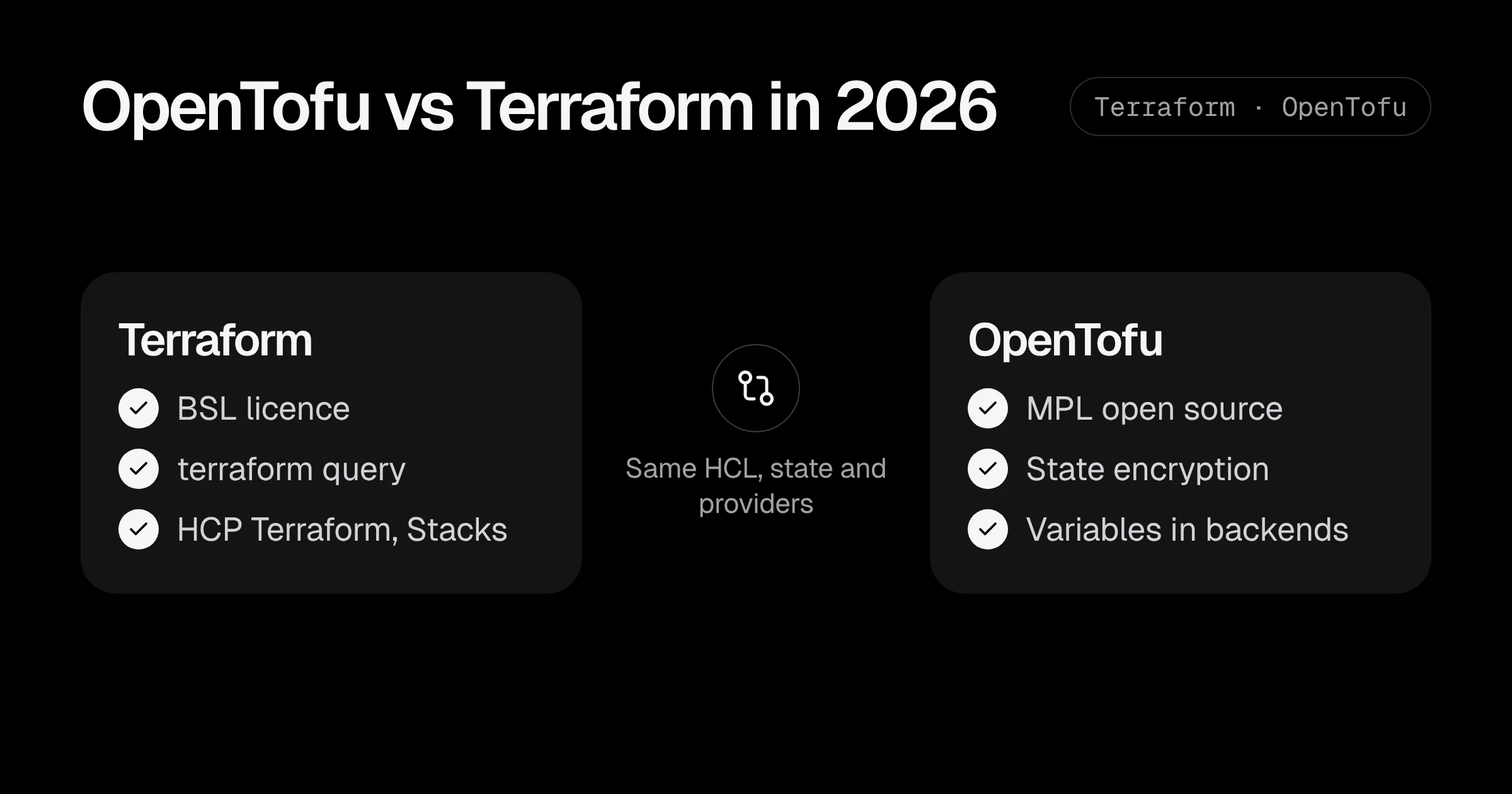
Every few months a founder or a new engineer asks me the same question: should we use Terraform or OpenTofu? Three years after the split, the honest answer for most startups is that both work, and the choice matters less than people think. What matters is picking one on purpose, knowing which features tie you to it, and keeping the door open.
Here is where things stand in late 2026, and how to decide.
How we got here
- August 2023: HashiCorp moved Terraform from the open-source MPL 2.0 licence to the Business Source License (BSL).
- Late 2023: The community forked the last open-source version (1.5) as OpenTofu, now hosted by the Linux Foundation under MPL 2.0.
- 2025: IBM completed its acquisition of HashiCorp. The licence stayed the same.
As of late October 2026, the current releases are Terraform 1.17 and OpenTofu 1.13 (Encore comparison, October 2026). Both ship regular releases, and both run the AWS provider you already use.
Does the licence affect your startup?
For most startups, no. The BSL restricts offering Terraform as a competing commercial product. Using Terraform to manage your own company’s infrastructure, in CI or on a laptop, is allowed.
Where it can matter:
- You build a product for other companies that runs Terraform for them (an internal developer platform you sell, a hosting product).
- Your company or your customers have a policy that requires open-source licences for core tooling.
- You want the security of a community-governed project that no single company can change.
If none of those apply, choose on features and ecosystem instead.
Features only one of them has
Both tools have moved on since the fork, mostly in different directions:
| Feature | Terraform | OpenTofu |
|---|---|---|
| Same HCL, state format and AWS provider | Yes | Yes |
| Provider-defined functions | 1.8+ | 1.7+ |
| Ephemeral resources (secrets that never touch state) | 1.10+ | 1.11+ |
| State and plan encryption | No | 1.7+ |
| Variables and locals in the backend block | No | 1.8+ |
for_each on provider configurations |
No | 1.9+ |
-exclude flag for plans |
No | 1.9+ |
| Modules from OCI registries | No | 1.10+ |
terraform query and list blocks (bulk import) |
1.14+ | No |
| Actions blocks | 1.14+ | No |
| Stacks (multi-deployment orchestration) | HCP Terraform | No |
Source: Encore’s 2026 comparison and each project’s release notes.
The two that small teams care about most:
- State encryption (OpenTofu). Terraform state contains secrets: database passwords, generated keys, outputs. OpenTofu can encrypt the state file itself with a KMS key, so a leaked state file is useless. With Terraform, you rely on the S3 bucket’s encryption and access policy, which is fine if done well: see Terraform remote state on S3 with KMS.
- Bulk import (Terraform).
terraform querysearches the account and writes import blocks for you, which saves hours when bringing a click-built account into code: see importing existing AWS resources into Terraform.
What it looks like in the code
OpenTofu’s state encryption, using a KMS key you already have:
terraform {
  encryption {
    key_provider "aws_kms" "main" {
      kms_key_id = "alias/tofu-state"
      region     = "us-east-1"
      key_spec   = "AES_256"
    }
    method "aes_gcm" "main" {
      keys = key_provider.aws_kms.main
    }
    state {
      method = method.aes_gcm.main
    }
    plan {
      method = method.aes_gcm.main
    }
  }
}
And OpenTofu’s variables in the backend block, which Terraform still does not allow:
variable "env" {
  type = string
}

terraform {
  backend "s3" {
    bucket       = "acme-tofu-state"
    key          = "${var.env}/network.tfstate"
    region       = "us-east-1"
    use_lockfile = true
  }
}
The moment you add either of these, your code only works with OpenTofu. That is fine if it is a decision, not an accident.
How to choose
Pick Terraform if:
- You use or plan to use HCP Terraform (runs, policy, private registry, Stacks).
- You want
terraform queryand the newest Terraform features as soon as they ship. - Your team, contractors and hiring pool all know “Terraform” and you see no reason to change.
Pick OpenTofu if:
- You need or prefer an open-source licence and community governance.
- You want state encryption without extra tooling.
- You run your own CI pipeline (GitHub Actions, GitLab) and do not need HCP Terraform.
If you are unsure, start with whichever your team already knows, and avoid the features in the bold rows of the table for now. That keeps switching cheap.
Switching from Terraform to OpenTofu safely
The tools share a state format, so there is no data to convert. Test it on a copy first:
# 1. Install OpenTofu next to Terraform (example: macOS or Linux with Homebrew)
brew install opentofu
tofu version

# 2. Work on a copy of the state, not production
terraform state pull > backup.tfstate

# 3. Initialise and plan with OpenTofu
tofu init
tofu plan
The plan should say No changes. If it does, switch CI by replacing the setup step. In GitHub Actions:
- uses: opentofu/setup-opentofu@v1
  with:
    tofu_version: 1.13.2
- run: tofu init -input=false
- run: tofu plan -input=false -no-color
Things to check before switching:
- Your Terraform version. Moving from a Terraform release much newer than OpenTofu’s base can mean state written by newer features. Check that
tofu planreads it cleanly. - Terraform-only features in your code:
listblocks,actionblocks, HCP Terraformcloudblocks. Remove or replace them first. - Lock files. Run
tofu init -upgradeonce so.terraform.lock.hclrecords providers from the OpenTofu registry, and commit it.
Going back the other way works the same, as long as you have not used OpenTofu-only features such as state encryption.
My default for small teams
For a startup with one or two AWS accounts, a GitHub Actions pipeline and no HCP Terraform, I am comfortable with either, and I set up both for clients. What matters far more than the tool:
- State in a versioned, encrypted, locked S3 bucket.
- Every change through a pull request with a plan in the review.
- No long-lived AWS keys in CI: see GitHub Actions to AWS with OIDC.
- A scheduled check that catches manual changes: see Terraform drift detection.
Get those right and either tool will serve you well for years.
OpenTofu vs Terraform checklist
- Check whether the BSL licence actually affects your business. For most startups it does not.
- List the features you need: state encryption points to OpenTofu, terraform query and HCP Terraform point to Terraform.
- Pick one on purpose and write the decision down.
- Avoid features only one tool has, unless you chose that tool for them.
- If you switch, test
planon a copy of the state and expect “No changes”.
Need a second opinion on your setup? The Terraform consulting service works with both, or start with a Free AWS Review.
Version and feature information is from Encore’s OpenTofu vs Terraform comparison (updated October 2026), the OpenTofu documentation and the Terraform documentation, checked in November 2026.
Common questions
Is OpenTofu a drop-in replacement for Terraform?
For most AWS setups, yes. OpenTofu was forked from Terraform 1.5, reads the same HCL and state, and uses the same providers. Differences appear only when you use a feature that exists in one tool and not the other.
Is Terraform still free to use?
Yes, for running it against your own infrastructure. Terraform has been under the Business Source License since August 2023, which restricts building products that compete with HashiCorp. Using it to manage your company's AWS account is allowed.
Which one should a new startup choose?
If you want HCP Terraform, Stacks or the newest Terraform features, choose Terraform. If you want an open-source licence, state encryption, or you are worried about vendor direction, choose OpenTofu. Either is a good choice; switching later is not hard if you stay on common features.
How do I switch from Terraform to OpenTofu?
Install OpenTofu next to Terraform, copy the state, run tofu init and tofu plan, and confirm the plan shows no changes. Then replace terraform with tofu in CI and in your documentation.
Do OpenTofu and Terraform use the same providers?
Yes. OpenTofu has its own registry that mirrors the same providers, including hashicorp/aws, so your provider blocks and versions keep working.
Want this set up for your team?
I build this kind of infrastructure for startups and small teams, with fixed prices and full handover.