EC2 vs ECS vs EKS: the same app three ways, real monthly cost
One app on EC2, ECS Fargate and EKS: about $19, $13 and $132 a month. What each one costs, what you still manage, and when each is the right choice.
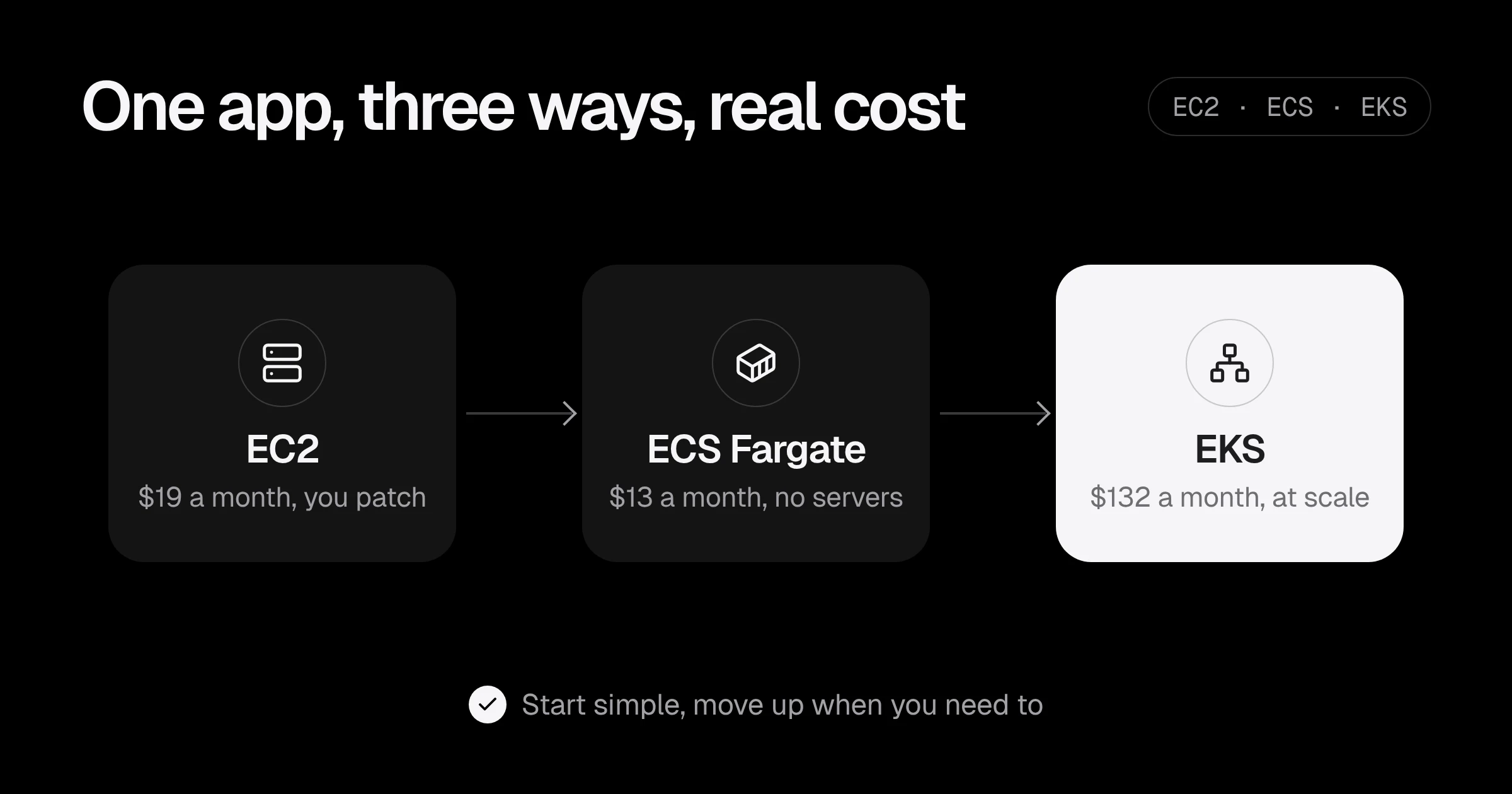
There are three common ways to run a container on AWS: on an EC2 server you manage, on ECS with Fargate, where AWS runs the containers for you, or on EKS, managed Kubernetes. To compare them fairly, I deployed the same small Go app all three ways from the same Docker image, and priced each one for a month.
| Way | What you pay for (us-east-1) | About a month | Who patches the servers |
|---|---|---|---|
| EC2 | 1 x t3.small, 8 GB gp3, public IPv4 | $19 | You |
| ECS on Fargate | 0.25 vCPU + 0.5 GB task, public IPv4 | $13 | AWS |
| EKS | Control plane, 2 x t3.small nodes, load balancer, IPv4 | $132 | You (nodes) and AWS (control plane) |
The app and one image for both CPUs
The app is about 45 lines of Go: a hello page, a /health endpoint and a /work endpoint that burns some CPU. The Dockerfile builds it for Intel and Graviton at once, so the same tag runs anywhere:
docker buildx build --platform linux/amd64,linux/arm64 \
  -t 123456789012.dkr.ecr.us-east-1.amazonaws.com/demo-app:v1 --push .
Build once, deploy three times. Only the platform underneath changes.
Way 1: EC2, one server running Docker
The simplest setup is a server with Docker on it. In Terraform that is a security group, an instance role that can pull from ECR, and a few lines of user data:
user_data = <<-EOT
  #!/bin/bash
  dnf install -y docker
  systemctl enable --now docker
  docker run -d --restart always -p 8080:8080 ${var.image}
EOT
Cost: t3.small at $0.0208 an hour is $15.18 a month, the 8 GB gp3 disk $0.64, and the public IPv4 address $3.65. About $19 a month.
What you still own: operating system patches, Docker updates, restarts when the server dies, disk space, and scaling. With one server there is also no redundancy: if the instance or its zone has a problem, the app is down.
EC2 is right when you have one or two apps, a tight budget, and someone who is comfortable looking after Linux.
Way 2: ECS on Fargate, no servers
With Fargate you describe a task (image, CPU, memory, ports) and a service that keeps it running. There is no server to log in to and nothing to patch:
resource "aws_ecs_task_definition" "app" {
  family                   = "demo"
  requires_compatibilities = ["FARGATE"]
  network_mode             = "awsvpc"
  cpu                      = 256 # 0.25 vCPU
  memory                   = 512 # 0.5 GB
  execution_role_arn       = aws_iam_role.execution.arn
  container_definitions    = jsonencode([{ name = "app", image = var.image, portMappings = [{ containerPort = 8080 }] }])
}
Cost: 0.25 vCPU x $0.04048 plus 0.5 GB x $0.004445 per hour is $9.01 a month, plus $3.65 for the public IP. About $13 a month, cheaper than the EC2 server because you pay for the task size, not a whole instance. On Graviton (ARM64) the task costs about 20% less again.
What you still own: the task definition, the image, and the network. AWS replaces failed tasks, and running two tasks in two zones is one number in the service.
ECS on Fargate is right for most startups: from one service up to dozens, with no Kubernetes skills needed.
Way 3: EKS, managed Kubernetes
EKS gives you a real Kubernetes cluster. The app becomes a Deployment and a Service:
apiVersion: apps/v1
kind: Deployment
metadata: { name: app }
spec:
  replicas: 2
  selector: { matchLabels: { app: demo } }
  template:
    metadata: { labels: { app: demo } }
    spec:
      containers:
        - name: app
          image: 123456789012.dkr.ecr.us-east-1.amazonaws.com/demo-app:v1
          ports: [{ containerPort: 8080 }]
Cost: the control plane is $0.10 an hour, $73 a month before any node. Two t3.small nodes add $30.37, the load balancer created by the Service about $18, and the public IPs about $11. About $132 a month. If you fall behind on upgrades, the control plane moves to extended support at $0.60 an hour, $438 a month. Check your versions with the EKS version support checker.
What you still own: cluster upgrades every year or so (how to upgrade before extended support), node groups, add-ons, and the Kubernetes knowledge to run all of it. In return you get the whole Kubernetes ecosystem: Helm charts, operators, autoscalers, and portability between clouds.
EKS is right when many teams run many services, or when you need something only Kubernetes gives you.
Effort, side by side
| Item | EC2 | ECS Fargate | EKS |
|---|---|---|---|
| Time to first deploy | about 3 minutes | about 2 minutes | about 20 minutes (cluster create) |
| Config for this app | about 80 lines of Terraform | about 105 lines of Terraform | eksctl file + about 35 lines of YAML |
| Patching | You, every month | Nobody | You, for nodes and add-ons |
| Yearly upgrades | Operating system | None | Kubernetes version, one minor at a time |
| Good up to | 1 or 2 apps | Dozens of services | Hundreds of services |
Which one should you pick?
- One app, small budget, Linux skills in the team: EC2. Add a second server and a load balancer before you call it production.
- A startup with a few to a few dozen services: ECS on Fargate. It is the default I recommend most often.
- Many teams, many services, or a hard need for Kubernetes: EKS. Budget for the control plane and for the people who keep it upgraded.
Moving later is possible in every direction, because all three run the same Docker image. Starting simple costs less and rarely blocks you.
Want to see what your current setup costs, or plan a move between them? Try the AWS cost calculator, look at the Kubernetes and EKS service, or start with a Free AWS Review.
Prices are on-demand Linux prices in us-east-1 from the EC2, Fargate, EKS and VPC public IPv4 pricing pages, checked in November 2026.
Common questions
Is ECS cheaper than EKS?
For the same workload, yes. ECS has no control plane fee, while EKS charges $0.10 an hour per cluster (about $73 a month), or $0.60 an hour once a version is on extended support. The tasks or nodes cost the same either way.
Is Fargate more expensive than EC2?
Per vCPU-hour, Fargate costs more than a well-used EC2 instance. For small or spiky apps it is often cheaper, because you pay for exactly the task size instead of a whole instance that sits mostly idle, and you do not pay people to patch servers.
When should a startup use EKS?
When you run many services across several teams, need the Kubernetes ecosystem (Helm charts, operators, service mesh), or must stay portable across clouds. For a handful of services, ECS gets you there with far less work.
Can I move from ECS to EKS later?
Yes. Both run the same Docker images. Moving means rewriting the task definitions as Kubernetes manifests, plus the networking and deployment pipeline. Starting on ECS does not lock you in.
Do these prices include a load balancer?
The EC2 and ECS numbers do not: those demos use a public IP to keep them cheap. An Application Load Balancer adds about $16 a month plus usage. The EKS number includes the load balancer Kubernetes creates for the Service.
Want this set up for your team?
I build this kind of infrastructure for startups and small teams, with fixed prices and full handover.